






College News
AI in Aquaculture: A Student Success Story
08 May 2026
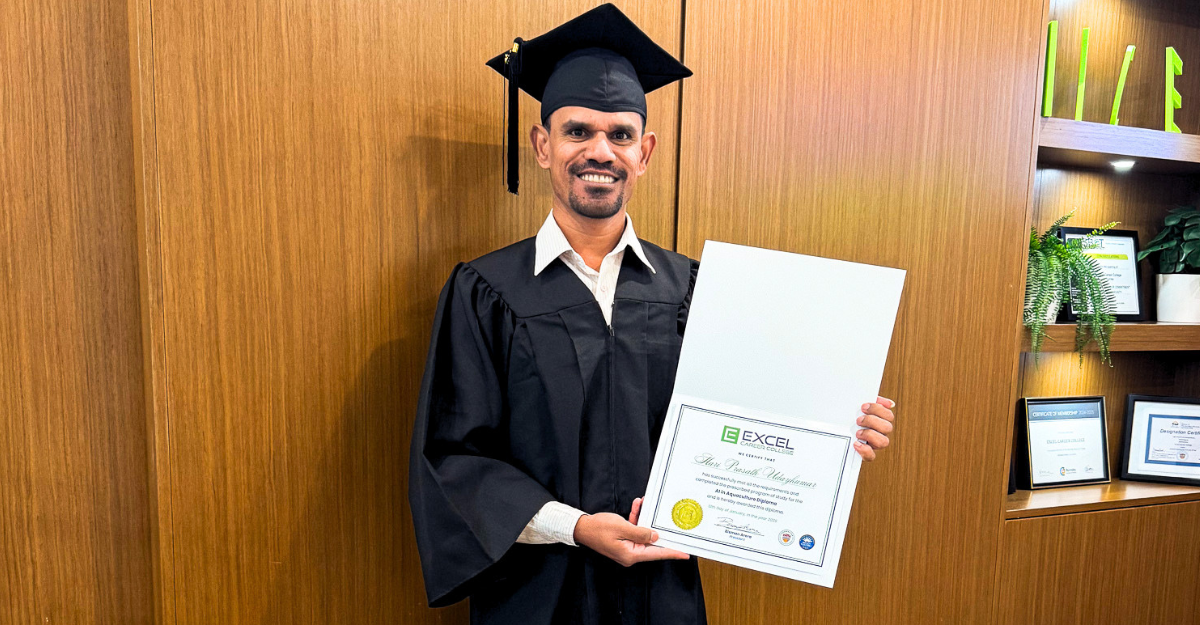
Table of contents
Subscribe to our newsletter
Thank you for subscribing to our newsletter! Stay tuned for updates.
Introduction
When Hari Udayakumar first learned about Excel Career College’s AI in Aquaculture program, he already had a vision, one that combined fish farming, aquaponics, and cutting-edge technology to grow both fish and medicinal herbs in a sustainable, organic system. What he didn’t know yet was exactly how to get there. That’s where ECC came in. Today, after completing one of British Columbia’s most forward-thinking aquaculture training programs, he has the certifications, hands-on experience, and industry confidence to make that vision a reality. Here’s how he did it.
Before the Program: A Vision Without a Roadmap
For Hari Udayakumar, the draw to aquaculture wasn’t accidental. He’d spent years connected to agriculture and natural systems, developing a genuine curiosity about how food is produced sustainably and what the future of the industry might look like.
“I’ve always been connected to agriculture and natural systems,” he explains, “and over time I became curious about aquaculture as a sustainable way to produce food.”
But curiosity alone doesn’t build a career. What he needed was a structured path that could translate that passion into practical, job-ready skills, and ideally one that didn’t ignore the technological revolution reshaping the industry. He was particularly interested in how AI and IoT (Internet of Things) could support aquaculture operations, a forward-looking interest that most programs simply weren’t addressing.
When the AI in Aquaculture program at Excel Career College crossed his path, it felt different.
Why He Chose Excel Career College
For prospective students weighing their options in British Columbia’s growing aquaculture sector, program choice matters. Hari Udayakumar was deliberate in his decision.
“I chose Excel Career College because the program was very practical and student-focused,” he says. “It combined aquaculture with digital skills and real-world applications, which made it feel relevant to industry needs.”
That combination, aquaculture science alongside digital literacy, data analysis, and AI integration, is what sets ECC’s program apart from traditional fisheries or marine biology diplomas. Rather than treating technology as a separate track, the AI in Aquaculture program weaves it into every aspect of the curriculum. For someone who wanted to explore the intersection of sustainable food production and modern technology, it was the right fit.
Excel Career College, with campuses across British Columbia in Surrey, Victoria, and Kelowna, has built its reputation since 1989 on practical, career-focused education. The AI in Aquaculture program is a natural extension of that philosophy into one of BC’s most important and growing industries.
Inside the Program: Hands-On Learning That Felt Like the Real Thing
When asked, Hari Udayakumar, what stood out most about his training, he doesn’t hesitate: it was the fact that everything felt purposeful and applied, not abstract or theoretical.
One example he returns to is the work with data tools like Excel, applied to real aquaculture scenarios. “I enjoy working with data,” he says, “so analyzing and presenting information was very meaningful.” In a field increasingly shaped by sensors, monitoring systems, and AI-driven decision-making, the ability to collect, interpret, and communicate data is rapidly becoming a core industry skill, and the program treated it as such.
Then there were the industry certifications. By graduation, Hari Udayakumar had earned credentials in First Aid, WHMIS, SVOP (Small Vessel Operator Proficiency), Radio Operator, and Confined Space Entry. This suite of certifications didn’t just look good on a résumé, they signaled to employers that he was prepared to step onto a working aquaculture site on day one.
“These made the training feel very practical and job-oriented,” he reflects.
The diversity of the classroom itself was also part of the education. Students came from a range of professional backgrounds, which created a rich learning environment and opportunities to solve problems from multiple angles, a skill that translates directly to the collaborative, multi-disciplinary nature of modern aquaculture operations.
The Nova Harvest Practicum: A Week at a Real Oyster Farm
If there’s one experience that crystallized everything Hari Udayakumar had been learning in the classroom, it was the one-week practicum at Nova Harvest, a working oyster hatchery and farm located in Bamfield, on the west coast of Vancouver Island.
“We had a one-week practicum at Nova Harvest, an oyster hatchery and farm,” he explains. “It gave me a clear understanding of how a real shellfish operation works.”
Day to day, students weren’t passive observers. They participated in seeding oyster float systems, harvesting, cleaning, and sorting, tasks that gave them direct exposure to the operational rhythms of a commercial shellfish farm. The practicum also helped students understand how hatchery production connects to on-farm grow-out, revealing the full lifecycle of a shellfish operation in a compressed, intensive format.
“It gave me a full picture of the cycle and the level of care and precision required,” he says.
For students considering a career in aquaculture in British Columbia, where the shellfish industry is a significant economic driver along the province’s 27,000 kilometres of coastline, this kind of site-based learning is invaluable. It’s one thing to understand oyster biology in a classroom; it’s another to understand the logistics, timing, and attention to detail that a commercial operation demands.
What Surprised Him: It Felt Like Industry Preparation, Not Just School
Hari Udayakumar came into the program with some expectations, but a few things caught him off guard, in the best way.
“I was surprised by how focused the program was on preparing students for real jobs,” he says. “The combination of classroom learning, certifications, and practicum experience created a strong foundation.”
The program also opened doors to professional networking within the BC aquaculture community. Industry professionals engaged with the class, bringing real-world perspectives into the curriculum and helping students build the kinds of connections that matter when you’re starting in a specialized field.
More unexpectedly, the experience shaped how he approaches challenges and works within a team, not just technical competence, but also professional confidence.
“It helped me build confidence, not just in technical skills, but also in how I approach problems and work in a team,” he reflects.
This kind of confidence is hard to quantify, but it’s often exactly what separates candidates who can succeed in entry-level roles from those who struggle to make the transition from training to employment. For a closer look at the range of roles this training opens up, check our aquaculture careers in BC guide.
Advice for Anyone Curious About Aquaculture
One of the most common barriers for prospective students considering a career change into aquaculture is the assumption that they need prior experience in the field. Hari Udayakumar pushes back on this directly.
“I would say don’t worry about experience,” he says. “This is a field where you learn by doing.”
His advice is simple: come with openness, effort, and consistency. The AI in Aquaculture program at Excel Career College is designed to meet students at their starting point, whatever that may be, and build their skills through structured, progressive exposure to the industry. To understand the bigger picture of why this industry matters, it helps to know what aquaculture is and why it matters, from feeding a growing global population to protecting wild fish stocks and supporting coastal communities.
“If you are open to learning, willing to put in effort, and stay consistent, you can build your skills step by step. The program gives you a solid starting point and exposure to different areas of the industry.”
In a province where the aquaculture sector is expanding, and where demand for workers who understand both the biology and the technology of fish and shellfish production is growing, that starting point matters.
Conclusion: A Foundation for What Comes Next
Hari Udayakumar’s story isn’t one of an overnight transformation. It’s about taking a long-held curiosity about sustainable food systems, pairing it with the right training environment, and building a foundation that makes the next steps possible.
Excel Career College’s AI in Aquaculture program gave him the technical skills, the industry credentials, the real-world practicum experience, and the professional confidence to move forward in a field he genuinely believes in. And his original vision, combining fish farming with aquaponics, medicinal herbs, and AI-driven monitoring systems, feels closer now than when he enrolled.
“It feels like a strong foundation for moving forward in the aquaculture field,” he says.
Ready to Start Your Journey in Aquaculture?
If you’re drawn to British Columbia’s coastlines, passionate about sustainable food systems, or simply looking for a career that puts you to work in one of the province’s most dynamic industries, Excel Career College’s Aquaculture Technician Diploma might be exactly where your story begins.