






Currently Enrolling
Medical Laboratory Assistant
Medical Laboratory Assistant
About the Program
The Medical Laboratory Assistant (MLA) Certificate Program prepares students with the knowledge, skills, and professional competencies required to work confidently and safely in modern laboratory environments. This program trains learners to perform essential pre-analytical procedures including specimen collection, phlebotomy, ECG testing, data entry, sample preparation, and quality assurance practices while adhering to strict infection control, safety, and patient-care standards. Students develop proficiency in collecting and processing blood, urine, and other biological specimens, maintaining accurate documentation, supporting workflow efficiency, and communicating effectively with patients and interdisciplinary health-care teams. Coursework integrates medical terminology, clinical chemistry, microbiology, urinalysis, ECG, and phlebotomy, ensuring graduates understand both the theoretical principles and the applied procedures that underpin safe, ethical, and accurate laboratory practice.
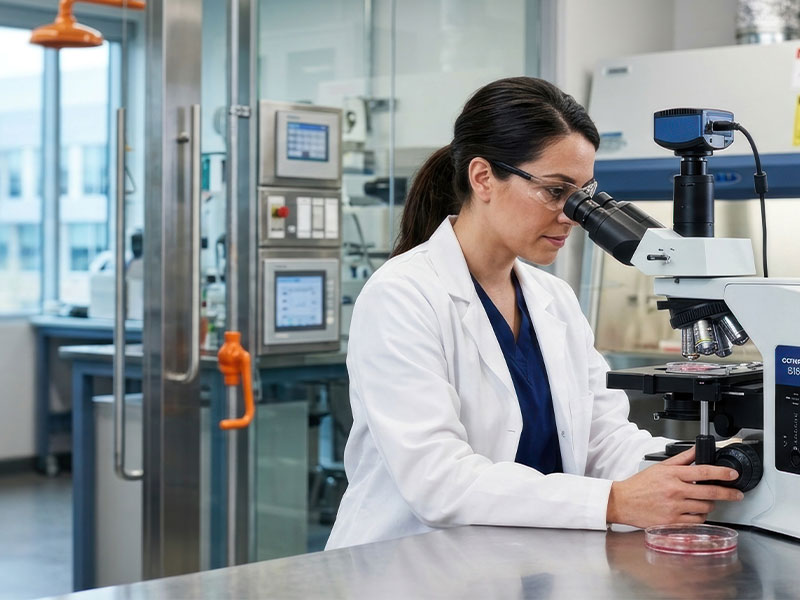
The Medical Laboratory Assistant Program blends classroom learning with extensive hands-on training, including a supervised practicum in a public or private laboratory setting. The practicum experience reinforces BCSLS-aligned competencies in specimen handling, data management, patient interaction, professional behaviour, and workplace readiness. With a strong combination of technical and administrative skills, graduates are prepared for employment in hospitals, public health laboratories, private diagnostic laboratories, physician offices, and other clinical environments.
The Medical Laboratory Assistant Program was reviewed and approved by the registrar of the Private Training Institutions Regulatory Unit (PTIRU) of the Ministry of Post-Secondary Education and Future Skills.

LABORATORY
Safety

CLINICAL LAB &
PHLEBOTOMY
MEDICAL
Terminology
Anatomy &
Physiology
Contact our Admissions Advisor for More Information Now!
Contact our Admissions Advisor for More Information Now!
Career Opportunities
Medical Laboratory Aide

Medical Laboratory Assistant

Pathology Assistant

Phlebotomy Aide
Courses
Administrative Office Procedures
The objective of this course is to introduce students to practical, professional and up-to-date office skills for today’s business environment.
Interpersonal Communication
This course focuses on the development of self-awareness, increased understanding of others and development of effective interpersonal communication skills that can be used in a variety of care giving contexts. Students will be encouraged to become more aware of the impact of their own communication choices and patterns. They will have opportunity to develop and use communication techniques that demonstrate personal awareness, respect and active listening skills.
Infection Control and Standard Precautions
This course introduces infection control principles, transmission prevention, aseptic techniques, and the role of medical lab assistants in infection prevention in a healthcare setting.
Professionalism, Ethics and Legislation
This course is designed to allow students to consider issues around professionalism, such as ethical decision-making; standards of practice; accountability; and the Legal and Regulatory frameworks within which Medical Laboratory Assistants (MLAs) must practice. The emphasis will be on employment within the province of B.C.
Foundations of Medical Terminology
In this course, students will learn the fundamentals of medical terminology by examining the history, word use, application of medical terms, and principles of medical word building.
Anatomy and Physiology
This course introduces human body system’s structure, anatomy, physiology, including sight and hearing. Detailed exploration of medical terminology for each system is facilitated by a specialized textbook, fostering a strong and coherent medical vocabulary.
Measurement and Laboratory Mathematics
This course enhances students’ mathematical abilities for medical laboratory settings. It emphasizes critical thinking, problem-solving, and building confidence in basic math. Topics include measurement, solution dilutions, chemistry, urinalysis, and math for Quality Assurance Programs.
Quality Management and Improvement
This course covers the essentials of Quality Phlebotomy, Quality Control (QC), and Quality Assurance (QA), along with Total Quality Management (TQM) and Continuous Improvement practices. Students delve into internal and external QA processes, including Workflow Analysis, Procedure Creation, and validation, while addressing 12 Quality System Essentials (QSEs). The emphasis is on Preanalytical, Analytical, and Post-analytical aspects, encompassing specimen handling, patient preparation, special collections, transportation, and processing.
Laboratory Safety
This course covers lab safety, equipment care, maintenance, and reagent prep. It teaches recognizing, handling, and disposing hazardous materials. Occupational health, safety, first aid (Standard First Aid Level C), CPR, and AED use will be taught.
The Clinical Laboratory and Phlebotomy
Basic Hematology and Immunology
This course covers theoretical foundations of hematology in medical labs, including Blood cell creation, whole blood components, coagulation, serology, transfusion medicine, and immunology. Quality assurance in hematology lab sections will also be explored.
Basic Clinical Microbiology
This course introduces students to basic microbiology fundamentals, including quality control; safety; Blood Culture collection; setup; culture media; inoculation; incubation; staining procedures; using microscopes; urinalysis culture and sensitivity. Students are given insight into systems and methods for the identification of microorganisms and subsequent decisions on patient treatments and other actions.
Basic Clinical Chemistry
The principles and theory of chemical analysis performed on clinical specimens will be introduced, including specimen processing, analysis, test interpretation, and quality control procedures used in both manual and automated clinical chemistry testing; Urinalysis. Students will cover both routine and more specialized clinical chemistry tests.
Collection and Handling of Urine Specimens
This course covers the theory and principles of urinalysis in clinical labs. It includes renal system anatomy, urine formation, and microscopic urine sediment examination. It also addresses fecal and other fluid analysis methods, emphasizing skill development in proper collection, testing, and safety precautions.
Introduction to Cytology and Histology
This course introduces students to basic theoretical knowledge of histology and cytology as medical science disciplines. Students will develop an understanding of the microscopic structure, organization and function of human cells and tissues in health, disease, develop expertise and practical skills in the techniques used in collecting and preparing specimens for diagnostic purposes.
Cardiovascular System and ECG
This course offers a detailed study of heart anatomy, its electrical system, ECG performance, blood pressure monitoring, equipment usage, maintenance, and analysis of tracings, including identification of critical cases.
* Students must demonstrate 10 technically accurate electrocardiograms prior to the start of the practicum
MLA Practicum
Admission Requirements
Students are required to be 19 years of age prior to the start of the program or possess a high school diploma (or equivalent), a minimum typing speed of 40 words per minute, and provide evidence of one of the following English proficiency requirements:
● Evidence that 3 years of full-time secondary education (Grades 8-12), or 2 years if the Grades are 10, 11, or 12, have been successfully completed in the program’s language of instruction in a country where the language of instruction is one of the principal languages.
● Completion of 2 years of full-time post-secondary education at an accredited
institution where English is the language of instruction, or
● Provide verified results for one of the English language proficiency tests listed below. Test results must be dated no more than two years before the start date
of the program:
● International English Language Testing System (IELTS) Academic Minimum overall score of 5.5
● Test of English as a Foreign Language (TOEFL) IBT – Minimum overall score of 46
● Canadian Academic English Language Assessment (CAEL) – Minimum overall score of 40
● Canadian English Language Proficiency Index Program (CELPIP): Listening 6, Speaking 6, Reading 5, and Writing 5
● Duolingo English Test (DET) – Minimum overall score of 95
● Pearson Test of English (PTE) Academic – Minimum overall score of 43
● Cambridge English Qualifications: B2 First exam (FCE) – Minimum overall
score of 160 or “C”
● Cambridge Linguaskill – Minimum overall B2 level
● LANGUAGECERT Academic – Minimum overall B2 level
● The Michigan English Test (MET) – Minimum overall B2 level
● iTEP Academic – Minimum overall score of 3.5
● EIKEN – Minimum placement of Grade Pre-1
Mature student applicants:
● Applicant is 19 years or older at the start of the program and is a Canadian
citizen or permanent resident who cannot access is their educational records or
provide sufficient evidence of secondary or post-secondary education as
outlined above:
● Applicant provides attestation that they have completed at least three years of full-time instruction in English in a country where the English is one of the principal languages, and
● Applicant completes an Accuplacer English Assessment (Next Generation: Reading, Writing and WritePlacer) and achieves the following minimum scores:
– Reading: 230
– Writing: 230
– WritePlacer: 4
Students are required to be 19 years of age prior to the start of the program or possess a high school diploma (or equivalent), a minimum typing speed of 40 words per minute, and provide evidence of one of the following English proficiency requirements:
● Evidence that 3 years of full-time secondary education (Grades 8-12), or 2 years if the Grades are 10, 11, or 12, have been successfully completed in the program’s language of instruction in a country where the language of instruction is one of the principal languages.
● Completion of 2 years of full-time post-secondary education at an accredited
institution where English is the language of instruction, or
● Provide verified results for one of the English language proficiency tests listed below. Test results must be dated no more than two years before the start date
of the program:
● International English Language Testing System (IELTS) Academic Minimum overall score of 5.5
● Test of English as a Foreign Language (TOEFL) IBT – Minimum overall score of 46
● Canadian Academic English Language Assessment (CAEL) – Minimum overall score of 40
● Canadian English Language Proficiency Index Program (CELPIP): Listening 6, Speaking 6, Reading 5, and Writing 5
● Duolingo English Test (DET) – Minimum overall score of 95
● Pearson Test of English (PTE) Academic – Minimum overall score of 43
● Cambridge English Qualifications: B2 First exam (FCE) – Minimum overall
score of 160 or “C”
● Cambridge Linguaskill – Minimum overall B2 level
● LANGUAGECERT Academic – Minimum overall B2 level
● The Michigan English Test (MET) – Minimum overall B2 level
● iTEP Academic – Minimum overall score of 3.5
● EIKEN – Minimum placement of Grade Pre-1
Mature student applicants:
● Applicant is 19 years or older at the start of the program and is a Canadian
citizen or permanent resident who cannot access is their educational records or
provide sufficient evidence of secondary or post-secondary education as
outlined above:
● Applicant provides attestation that they have completed at least three years of full-time instruction in English in a country where the English is one of the principal languages, and
● Applicant completes an Accuplacer English Assessment (Next Generation: Reading, Writing and WritePlacer) and achieves the following minimum scores:
– Reading: 230
– Writing: 230
– WritePlacer: 4
Frequently Asked Questions (FAQ)
Where can a Medical Laboratory Assistant work?
A Medical Laboratory Assistant can work in hospitals, public health laboratories, private diagnostic laboratories, physician offices, and other clinical healthcare environments. Depending on the workplace, graduates may find opportunities under job titles such as medical laboratory assistant, medical laboratory aide, pathology assistant, or phlebotomy aide.
Does the Medical Laboratory Assistant program include hands-on training?
Yes. The program combines classroom learning with hands-on training and includes a supervised 120-hour practicum in a public or private laboratory setting. The practicum gives students an opportunity to apply their skills in areas such as specimen handling, data management, patient interaction, professional conduct, and workplace readiness.
What does a Medical Laboratory Assistant do?
A Medical Laboratory Assistant supports laboratory and healthcare teams with a variety of clinical and administrative tasks. Responsibilities may include collecting, labeling, preparing, and processing patient specimens, as well as supporting laboratory documentation and workflow. Specific duties can vary depending on the employer, workplace setting, and scope of the position.
What skills are important for a Medical Laboratory Assistant?
Medical Laboratory Assistants need strong attention to detail, organization, communication, and interpersonal skills. They must be able to follow safety procedures, handle specimens accurately, maintain proper documentation, work with laboratory equipment and technology, and communicate professionally with patients and healthcare teams.
What types of specimens does a Medical Laboratory Assistant learn to handle?
Students receive training in the collection and processing of blood, urine, and other biological specimens. Training emphasizes proper collection, labeling, sorting, handling, transportation, and processing according to laboratory quality and safety standards.
Is the Medical Laboratory Assistant program offered online or in person?
The program uses a combination of online and in-class learning. Online components are synchronous, meaning students attend virtual classes in real time with instructors and classmates. Courses requiring more practical training include in-class components, and the 120-hour MLA practicum is completed entirely in person.
720
total program
hours
24
weeks
total
6
months of
duration

Why Excel Career College?
Practical, hands-on programs designed to guide you every step of the way. Whether you’re switching careers, upskilling, or starting fresh, we’ll help you excel.
Discover the Excel Experience